
Kane County Warrant Search
Kane County does not publish a standalone public active warrant portal. That fact shapes every step of a Kane County warrant search. There is no single search box that lists everyone with an open warrant in the Sixteenth Judicial Circuit. The sheriff's inspected public pages did not expose a stand-alone active warrant lookup. The Circuit Clerk does not publish one either. Anyone who needs to confirm a warrant has to work around this gap with the official tools that exist.
Two tools do most of the work. The first is the Kane County Odyssey court portal, where a warrant often appears as a docket entry tied to a case number. The second is the sheriff detainee search, which shows whether a person is already in custody after a warrant arrest. Neither tool is a true warrant list. Both can confirm or rule out a warrant if used carefully. The Kane County Sheriff's Office Civil and Warrants Division handles service of warrants the office holds, and that office can answer direct phone questions.
For active criminal investigations, search warrants stay sealed. The Circuit Clerk will not display a sealed search warrant on the public docket. Some bench warrants and body attachments are visible on the case docket because the underlying case is open to the public. Other warrants are tied to juvenile or sealed files and never appear in the public search. The right plan is to start with the case portal, move to the detainee search if the person may already be booked, then call the Civil and Warrants Division as a last step before assuming there is no warrant.
Types of Warrants in Kane County
Several different orders fall under the word "warrant" in Kane County. A reader looking at a docket entry or talking to the Sheriff's Office needs to know which type is in play. The most common types in the Sixteenth Judicial Circuit are arrest warrants, bench warrants, search warrants, civil body attachments, and holds or detainers. Each one is issued for a different reason. Each one has its own rules about whether a court date, a bond, or a transfer follows.
The table below pairs each warrant type with a plain-English description. None of these are limited to Kane County, but all of them appear in Kane County Circuit Court files and in jail data from the Adult Justice Center.
| Warrant Type | What It Is |
|---|---|
| Arrest warrant | A judge-signed order to take a named person into custody based on a criminal complaint and probable cause. |
| Bench warrant | Issued by a judge from the bench, usually for a failure to appear, a probation violation, contempt, or failure to comply with a court order. |
| Search warrant | Authorizes a search of a place, vehicle, person, or property. Usually sealed during the investigation and not public on the docket. |
| Civil body attachment | A civil-side order that can issue in child support, contempt, or rule-to-show-cause matters when a party fails to appear. |
| Hold / detainer | A request by another agency (IDOC, ICE, another county or state) to keep a person in custody even after local bond. |
Knowing the type matters at the search stage. A search warrant rarely shows on the public docket. A bench warrant in an open misdemeanor case often does. A federal arrest warrant will not appear in the Kane County Odyssey portal at all because federal court files live in a separate system. A hold from IDOC or ICE is not a warrant in the usual sense but can have the same effect on whether someone is released.
How to Check for a Kane County Warrant
A Kane County warrant check works best as a step-by-step process. Start with what you know. A case number from a notice, citation, or summons is the cleanest input. A full name and rough date of birth come next. The goal at each step is to rule out a warrant or to confirm one without relying on third-party warrant sites, which often charge fees and may list outdated data.
- Open the Kane County Odyssey court portal and run a Smart Search by name or case number.
- Open any matching cases and read the docket entries for "warrant issued," "FTA warrant," "body attachment," "bench warrant," or similar entries.
- Note any recall, quash, or release date next to the warrant entry.
- If the person may already be booked, run a name through the Kane County detainee search to confirm current custody.
- Use the dashboard's Search Hearings tool to check whether the person is on a court calendar; a missed setting is what creates most bench warrants.
- If no docket entry appears and the person is not in custody, call the Kane County Sheriff's Office Civil and Warrants Division at 630-208-2010 for a direct check.
- For a warrant from another county, another state, or a federal agency, contact the issuing court or agency rather than the Kane County offices.
None of these steps will surface a sealed search warrant. None will display a juvenile warrant. None will list a warrant that has not yet been entered into the case management system. If a recent arrest just happened on a freshly issued warrant, the Adult Justice Center may show the person in the detainee search before the case docket catches up. Patience and a second pass a few hours later often clears that gap.
Searching Kane County Court Dockets for Warrant Entries
The Odyssey court portal is the closest thing Kane County has to a public warrant lookup. Warrant orders are recorded as docket events inside the case file. That means the search inputs are case-level, not warrant-level. The portal does not let a user search "all open warrants" the way a state-level criminal history might. It lets a user open a case and read whether the docket includes a warrant event.
The table below lists the practical ways to surface a Kane County warrant given that there is no standalone portal. Each row is an official channel. None of these are third-party warrant aggregators.
| Method | What It Returns |
|---|---|
| Odyssey case search by name | Public criminal, traffic, and civil cases that list a named party; warrant entries show inside the docket if the case is open to the public. |
| Odyssey case search by case number | The fastest route when the case number is known; opens the docket directly and exposes any warrant event. |
| Sheriff detainee search by name | Confirms whether a Kane County warrant arrest has already booked the person into the Adult Justice Center. |
| Sheriff detainee search by alphabet | Letter buttons A through Z; useful when the spelling of the name is uncertain. |
| Search Hearings on the Odyssey dashboard | Returns scheduled court settings; a missing or missed setting often correlates with a bench warrant. |
| Civil and Warrants Division phone (630-208-2010) | Direct contact with the Sheriff's Office unit that holds, serves, and tracks warrants assigned to Kane County deputies. |
A reader checking on a relative or a tenant should pair the case search and the custody search. A docket entry without a custody record usually means the warrant is still open. A custody record without a docket entry usually means the booking is newer than the public court update. Either way, an open warrant is not something to leave alone.
The Odyssey dashboard for Kane County shows the same tile layout used for case search, hearings, and payments.
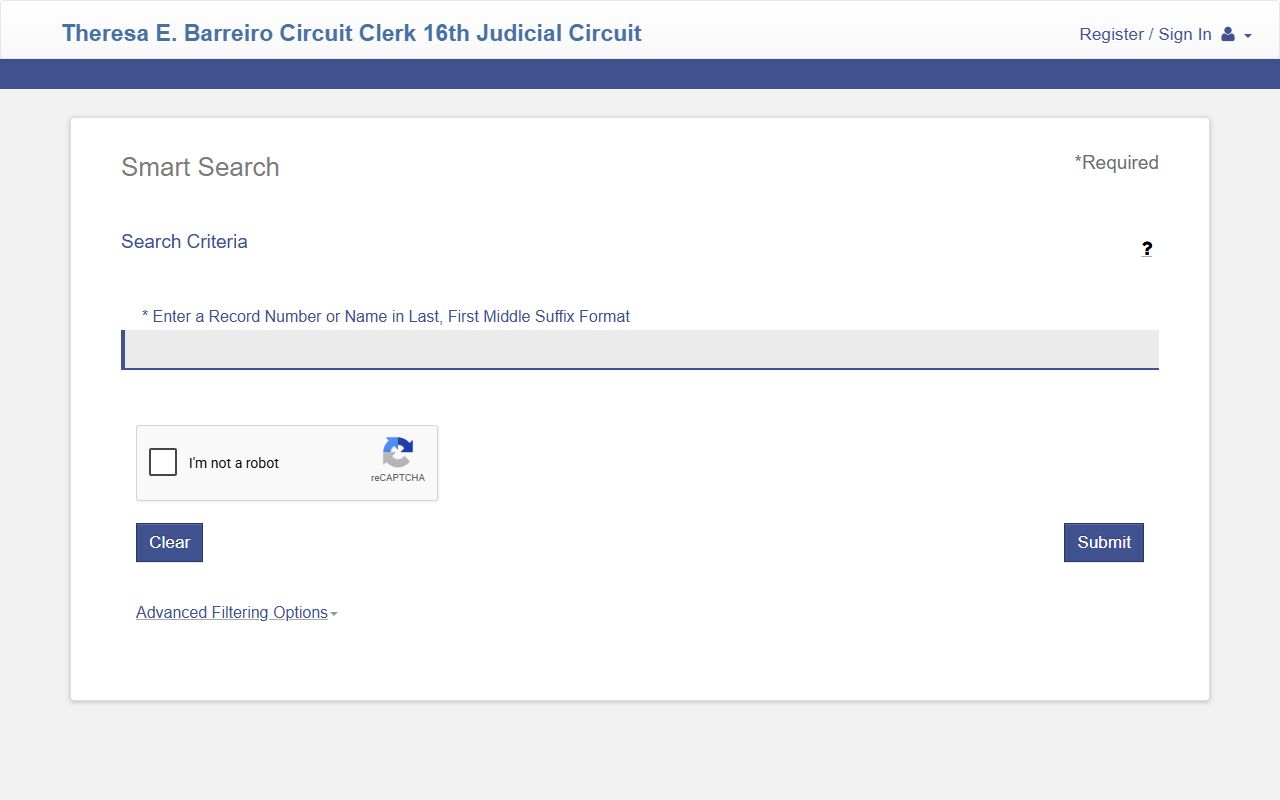
From the dashboard, Smart Search and Search Hearings are the two tiles a Kane County warrant search actually uses.
Searching Kane County Custody After a Warrant
If a warrant has already produced an arrest, the person will show in the sheriff detainee search instead of (or in addition to) the case docket. The Kane County Sheriff's Office runs the Adult Justice Center at 37W755 Illinois Route 38 in St. Charles. The detainee search exposes current custody plus the 72-hour received and released windows. A warrant arrest from the previous night is usually visible by morning.
The detainee profile reports charges as written at booking. A warrant-driven booking often lists the underlying offense, not the word "warrant" itself. A Kane County warrant for failure to appear on a DUI case, for example, will book the person back in on the DT case and show the DUI charge with a new court date. The case docket then connects the dots by recording the warrant return.
The Kane County detainee search at applications.kanecountyil.gov is the direct application used by the sheriff's website.
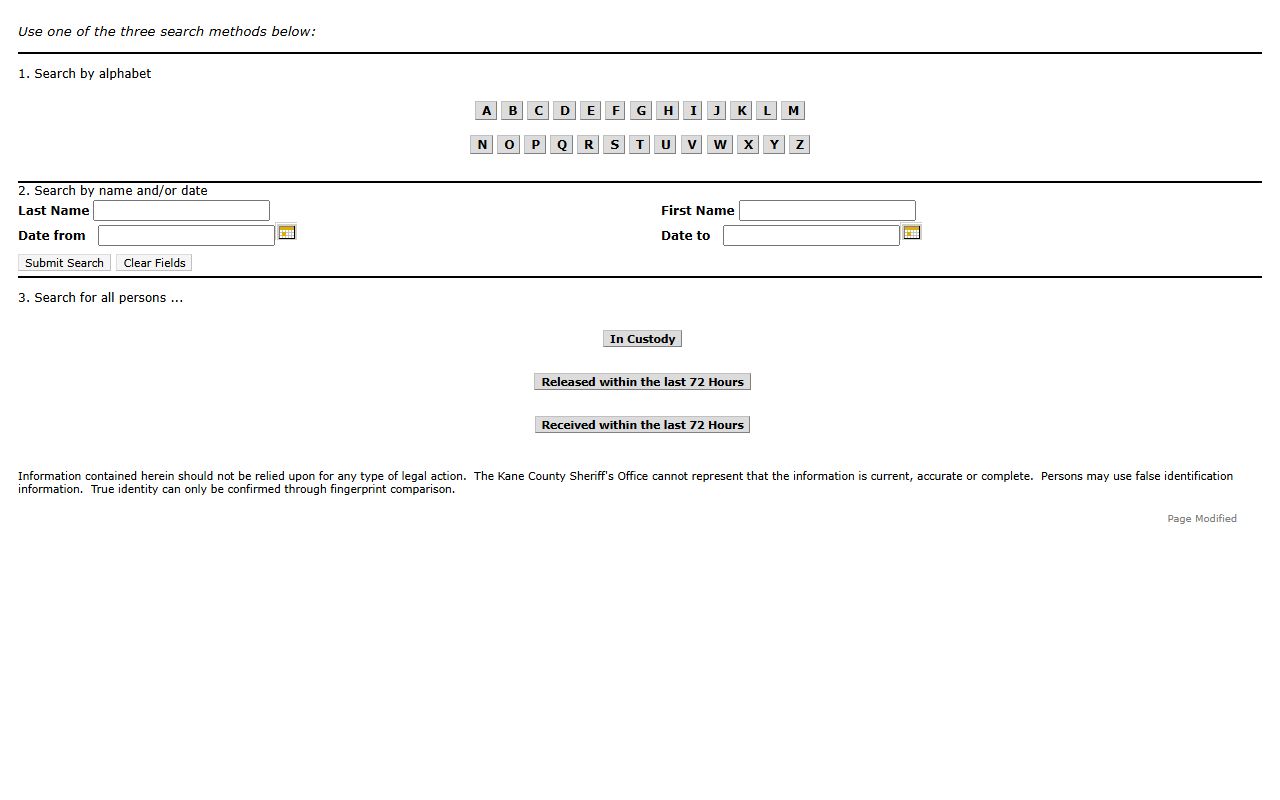
The same A-Z buttons and 72-hour custody filters used for ordinary jail roster lookups also serve as a Kane County warrant verification step after an arrest.
The Sheriff's Office Civil and Warrants Division
The Civil and Warrants Division inside the Kane County Sheriff's Office is the unit that handles warrant service for the county. Its direct phone line is 630-208-2010. Sheriff Ron Hain leads the office. The general administrative line is 630-208-2000. Hours on the contact page are 8:00 a.m. to 5:00 p.m. Monday through Friday, with a note that various divisions may keep extended hours and callers should confirm before relying on a particular schedule.
The unit does several things. It serves arrest warrants assigned to the Kane County Sheriff. It serves civil process, including subpoenas, summons, and body attachments. It coordinates with municipal police departments on warrants tied to local cases. It also coordinates with IDOC, ICE, and outside counties on holds. A caller asking about a specific person can usually get a basic yes or no on whether the Sheriff is holding an active local warrant. The unit does not give legal advice, does not negotiate bond, and does not set court dates.
The Sheriff's Office contact page lists the division phone numbers including the Civil and Warrants line.
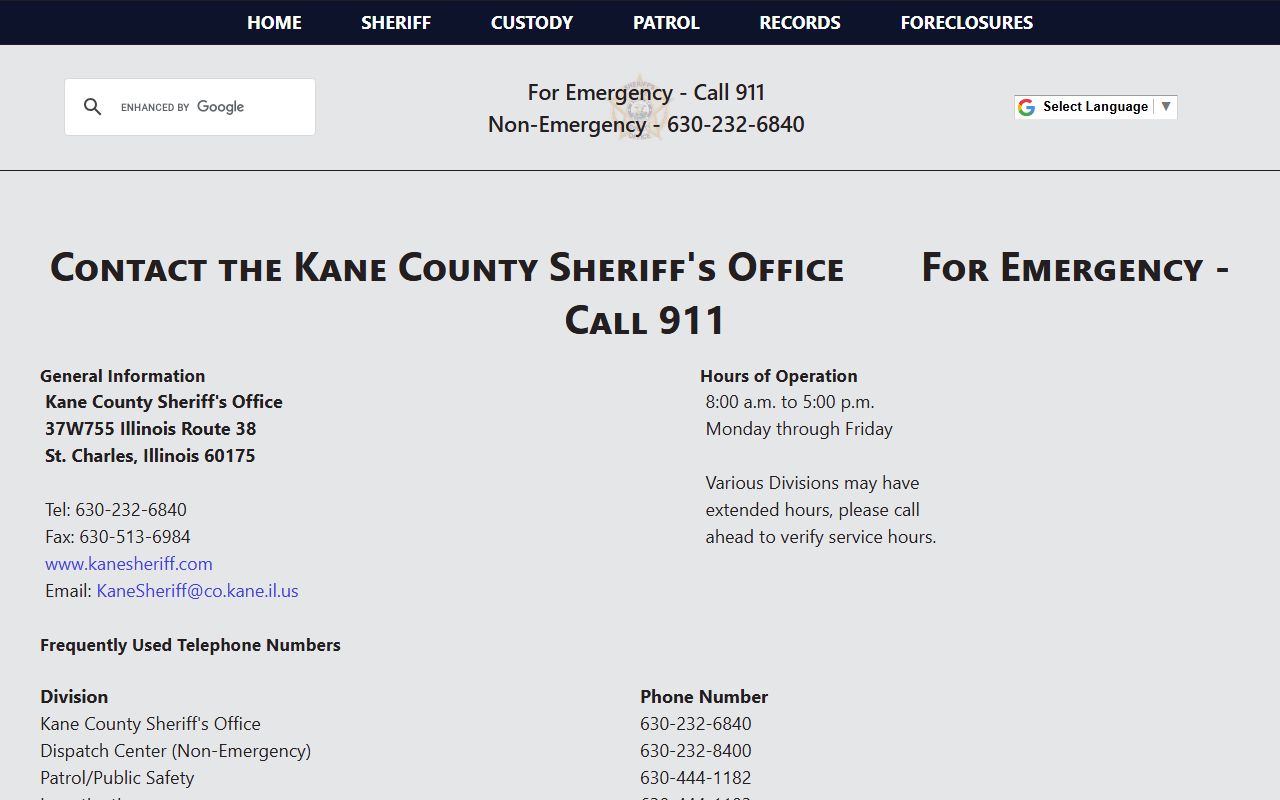
The contact directory groups the warrants line with court security, investigations, dispatch, and the jail desk, which is the order most callers move through.
What a Kane County Warrant Docket Entry Shows
A docket-level warrant entry inside a Kane County Circuit Court case is not a stand-alone record. It is one line, or a small group of lines, inside a longer case docket. The exact fields depend on the case type and on what the judge ordered. Below is a basic inventory of what a typical Kane County warrant entry exposes when the case file is open to the public.
| Field | What the Docket Entry Shows |
|---|---|
| Date issued | The date the judge signed or ordered the warrant. |
| Warrant type | Arrest, bench, body attachment, FTA (failure to appear), or other label. |
| Related charge | The underlying count or case event that triggered the order. |
| Bond amount | The bond figure tied to the warrant, if the judge set one. Often blank under the SAFE-T Act framework. |
| Recall or quash date | The date the court ordered the warrant withdrawn, if it was later cleared. |
| Next hearing | The next scheduled court date after the warrant return. |
The exact label text varies by case type and by the judge. A traffic case may say "warrant issued for FTA." A felony case may say "bench warrant" with an amount. A child support case may use "body attachment" or "rule to show cause" wording. None of these fields are guaranteed in every case. Anyone trying to pull warrant data for legal use should pair the docket entry with a certified copy of the order from the Circuit Clerk.
Bench Warrants for Missed Kane County Court Dates
Bench warrants are the most common warrant type a Kane County resident actually encounters. They are issued by the judge from the bench, usually when a defendant misses a scheduled hearing. They can also follow a probation violation, a missed payment, or a failure to file required paperwork. The order is recorded on the case docket and stays open until the warrant is served, recalled, or quashed.
Missing a court date in Kane County does not always trigger an immediate warrant. Some traffic and minor cases give the defendant a short grace period or rescheduled date. Many do not. A failure to appear on a DUI under DT, a felony under CF, a misdemeanor under CM, or a serious traffic matter under MT often produces a bench warrant the same day. The amount of the bond, if any, depends on the judge and the offense.
The fastest fix is to surrender voluntarily and ask the court to recall the warrant. An attorney can file a motion to quash and may be able to set the matter for a status hearing without a custody arrest. Ignoring a bench warrant rarely makes it go away. The warrant stays open until acted on, and contact with law enforcement on something unrelated, like a traffic stop, can lead to an arrest tied to the older case.
Holds and Detainers in Kane County
Holds and detainers are not warrants in the traditional sense, but they have the same effect on whether a person leaves the Adult Justice Center. The official sheriff FAQ states that staff check for outstanding warrants before any release. If a warrant is found, the detainee is not released and is sent to the agency holding the warrant. The FAQ also notes that holds from the Illinois Department of Corrections, U.S. Immigration and Customs Enforcement, and other agencies can keep a person in custody even after local bond is posted.
This rule surprises some families who arrive at the Sheriff's Office with cash bond. The bond may post. The case bond may clear. The person still stays in custody if there is an IDOC parole hold, an ICE detainer, an out-of-county warrant, or a federal hold. The sheriff cannot waive those holds. Transfer to the holding agency follows the rules of that agency.
- IDOC hold: usually tied to parole, mandatory supervised release, or an open prison-side matter; transfer is to the Illinois Department of Corrections.
- ICE detainer: a federal immigration hold; transfer follows federal immigration rules.
- Out-of-county warrant: another Illinois county has an open warrant; transfer is by sheriff-to-sheriff arrangement.
- Federal warrant: U.S. Marshals or another federal agency takes custody; the case moves to federal court.
Before posting bond on a person who may have any of these holds, call the Adult Justice Center to verify. The Kane County Civil and Warrants Division can confirm a Kane County warrant. The other holds require a call to the holding agency. The $100 sheriff bond processing fee is non-refundable even if the person stays in custody on a hold.
Federal Warrants Connected to Kane County
Federal warrants are not in the Kane County court portal. They live in the federal court system. Kane County sits inside the federal jurisdiction of the U.S. District Court for the Northern District of Illinois. Federal arrest warrants tied to Kane County residents, businesses, or incidents are issued by a federal magistrate or district judge and are served by federal agents.
The U.S. Marshals Service Northern District of Illinois is the federal agency that holds, tracks, and serves most federal warrants in the region. The Marshals coordinate with the Kane County Sheriff when a federal subject is in local custody and with federal partners on fugitive cases. Federal court records are searched through PACER rather than the Kane County Odyssey portal. A federal warrant will not appear in a local sheriff detainee search until the person is in federal or contract custody.
Federal sealed indictments can stay confidential until arrest. That means a Kane County resident may have a federal warrant out for them without anything showing in any public search. A criminal defense attorney with federal court experience is the right starting point if a federal warrant is suspected. A general phone call to the U.S. Marshals about an active investigation rarely confirms or denies a sealed federal warrant.
How to Resolve an Outstanding Kane County Warrant
An outstanding warrant does not go away on its own. The fix involves the issuing court, not the police. The right plan depends on the warrant type, the underlying case, and whether the person can post a bond if one is set. A Kane County resident with a bench warrant on an old case is in a different spot than someone with a fresh arrest warrant on a felony charge. Both, though, follow the same first three steps.
- Identify the issuing court and the exact case number. Use the Odyssey portal or call the Circuit Clerk at 630-232-3413 to confirm.
- Read the docket for any bond figure, recall conditions, or surrender instructions tied to the warrant.
- Contact a criminal defense attorney before walking into court or the jail; staff cannot give legal advice.
- If turning yourself in, confirm the surrender location with the Civil and Warrants Division at 630-208-2010 and ask whether a judge must set conditions first.
- Bring valid photo ID and exact cash if a cash bond is permitted; the sheriff accepts only exact amounts for cash bonds.
- Expect a check for other holds before release; IDOC, ICE, and other-county warrants can keep the person in custody.
- After resolution, pull the docket again to confirm the warrant was recalled or quashed and ask the Circuit Clerk for a certified copy of the recall order.
Ignoring a Kane County warrant has real consequences. A traffic stop can lead to a custody arrest. License or vehicle registration matters can stack on top of the original case. Federal immigration consequences may attach to certain criminal warrants. Where the warrant is connected to a missed traffic case, the Secretary of State may suspend the license under the Failure to Appear or Failure to Pay statutes. Resolving the warrant early limits those downstream problems.
Warrant Records and Sealing After Resolution
Once a Kane County warrant is recalled or quashed, the docket entry stays in the case file. It does not vanish on its own. If the underlying case ends in dismissal, acquittal, or another non-conviction outcome, the entire file (including the warrant history) may qualify for sealing or expungement under the Criminal Identification Act. The main statute is 20 ILCS 2630/5.2. The petition is filed in the same Kane County Circuit Court that handled the case.
Sealing hides the case from public search and most employers. Expungement is stronger and removes the record from public access entirely. Both remedies have eligibility rules tied to the offense, the disposition, and a waiting period. A warrant history alone does not automatically qualify a person for sealing; the case outcome controls. Free guidance is at Illinois Legal Aid Online, and the state publishes an expungement overview at illinois.gov.
Juvenile warrants follow different rules. Records under the Juvenile Court Act of 1987, 705 ILCS 405, are restricted from public view from the start. A juvenile delinquency warrant will not appear in the public Odyssey portal or the Kane County detainee search. Access goes through the court, the Public Defender, or a parent or guardian with statutory access.
FOIA does not usually reach court files. Court case records are obtained from the Circuit Clerk under court rules and clerk procedures rather than under 5 ILCS 140. The Clerks of Courts Act, 705 ILCS 105, makes the Circuit Clerk the custodian of those files. For non-court records held by the Sheriff's Office, such as incident reports or administrative warrant logs, FOIA is the correct route.
Note: Verify any Kane County warrant status through the Circuit Clerk or the Civil and Warrants Division before relying on a public search to confirm arrest, release, or recall.