
Kane County Marriage and Divorce Records
Two offices hold these records. The Kane County Clerk keeps marriage licenses and marriage certificates. The Kane County Circuit Clerk keeps divorce case files. They are not the same office, and they do not hold the same papers. A marriage record proves a couple got married. A divorce record proves a court ended that marriage. One starts a marriage. The other ends it.
The County Clerk is led by John A. Cunningham, with Chief Deputy Celeste Weilandt. That office issues the marriage license, records the signed license after the ceremony, and sells certified copies of the marriage certificate. It also runs a historical genealogy index for older births, marriages, and deaths. None of that touches divorce files. The County Clerk does not hold divorce decrees.
Divorce in Illinois is a court case. A petition for dissolution of marriage is filed with the Circuit Court, and the Kane County Circuit Clerk is the custodian of that file. Certified divorce decrees come from the Circuit Clerk, not the County Clerk. Public divorce docket data is searched in the same court portal used for other Kane County court records. The simple rule: marriage paper goes to the County Clerk, divorce paper goes to the Circuit Clerk.
Kane County Marriage Licenses (County Clerk)
The Kane County Clerk issues every marriage license in the county. A couple who plans to marry in Kane County applies here first. The license is the legal go-ahead for the ceremony. After the ceremony, the officiant returns the signed license to the County Clerk for recording, and only then can the office issue a certified marriage certificate.
The official rules for age, identification, prior-marriage proof, fees, and any waiting period are posted on the County Clerk site. The marriage license page is the place to confirm the current process before you go in. Read it first. Requirements and fees change, and the County Clerk page is the source of truth, not a third-party site.
You can see the County Clerk site for yourself at the official Kane County Clerk homepage, which links the marriage and vital records pages directly.
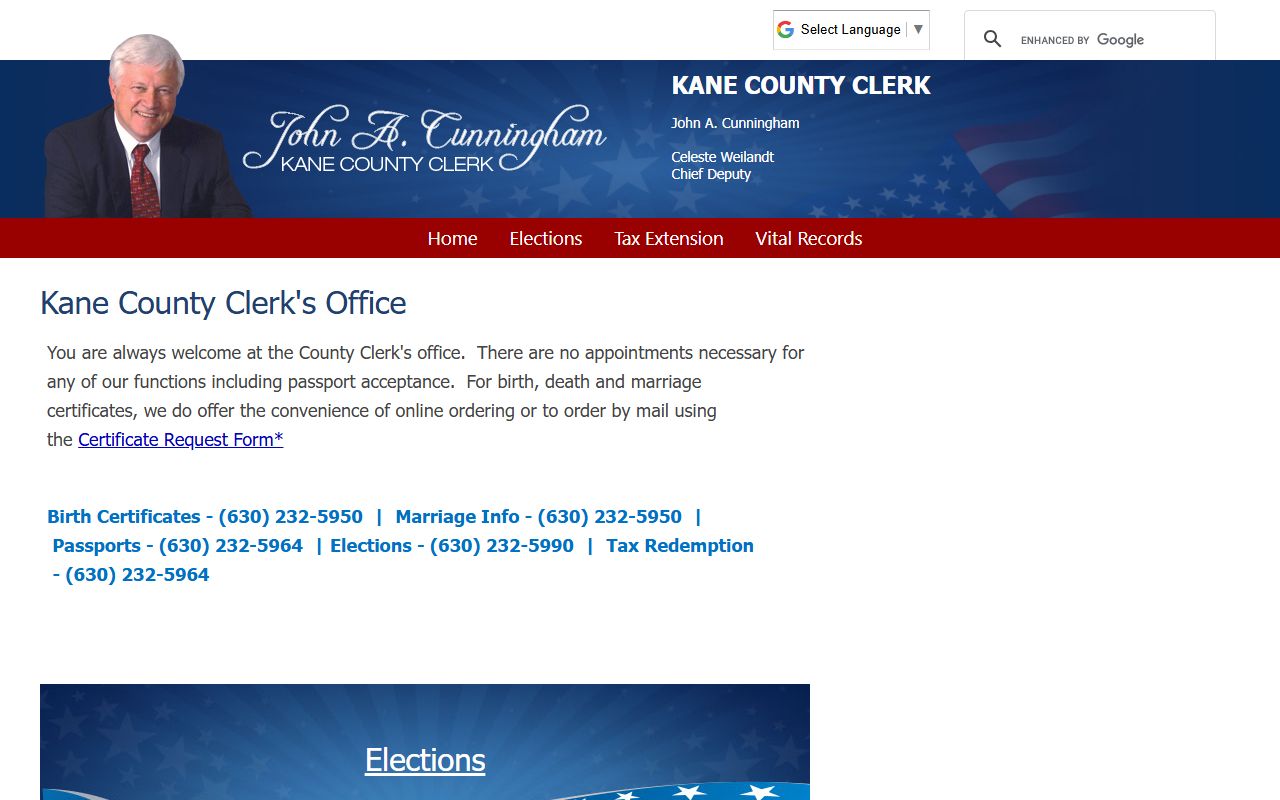
The homepage navigation points to the marriage license page and the vital records page, which is where current fees, ID rules, and hours are kept up to date.
How to Apply for a Kane County Marriage License
Applying is a short process when both people come prepared. Both parties usually apply together, and both bring valid government identification. The County Clerk page lists the exact ID it accepts and any document needed when a prior marriage ended by divorce or death. Confirm those details before you go.
- Read the County Clerk marriage license page and confirm both applicants meet Illinois eligibility rules.
- Gather government-issued photo ID for each applicant, plus proof of a prior divorce or a spouse's death if either applies.
- Complete any online pre-application or in-office paperwork the County Clerk requires.
- Apply together at the County Clerk office and sign the application as instructed.
- Pay the current marriage license fee set by the County Clerk.
- Receive the license, then have an authorized officiant perform the ceremony within the license validity period.
- Make sure the officiant returns the signed license to the County Clerk for recording, then request certified copies.
Note: A marriage license is not a marriage certificate; the license allows the ceremony, while the certificate proves it happened and is issued only after the signed license is recorded.
The Marriage License Application Form
The marriage license application asks each person for basic identity and history data. The fields below reflect the kind of information Illinois county clerks collect. Treat them as a checklist, not a copy of the live form. Verify the exact labels on the current County Clerk application before you fill anything out, since wording and required items can change.
| Field | Type | Required | Notes |
|---|---|---|---|
| Applicant 1 legal name | Text | Yes | Full legal name; verify exact label on the current County Clerk form. |
| Applicant 2 legal name | Text | Yes | Full legal name; verify exact label on the current County Clerk form. |
| Date of birth | Date | Yes | Illinois age eligibility rules apply to each applicant. |
| Residence address | Text | Yes | Current home address for each applicant. |
| Identification | Document | Yes | Government photo ID; quote the accepted ID list from the current Clerk page. |
| Prior marriage status | Checkbox / radio | Conditional | Divorce decree or death certificate may be required if a prior marriage ended. |
| Ceremony date | Date | Conditional | License has a set validity period from the issue date. |
| Signature / oath | Signature | Yes | The Clerk may require an in-person oath at the counter. |
Some details, like Social Security data, may be collected for state reporting and kept off the public record. Illinois does not put every application field into the public marriage index. The County Clerk page explains what shows and what stays private.
Certified Marriage Records and Genealogy Searches in Kane County
After a marriage is recorded, the County Clerk can issue a certified marriage certificate. A certified copy is the version most agencies accept for a name change, an immigration filing, a benefits claim, or a passport. Eligibility and ID rules apply to certified vital records under Illinois law. The vital records page lists who may request a copy and what proof is needed.
Older records work differently. The County Clerk runs a public historical index for genealogy research. The Kane County Clerk genealogy site lets researchers search by name and record type for historical births, marriages, and deaths. The index is free to search. A certified or paper copy still goes through the County Clerk's regular request process, with its own fee and eligibility rules.
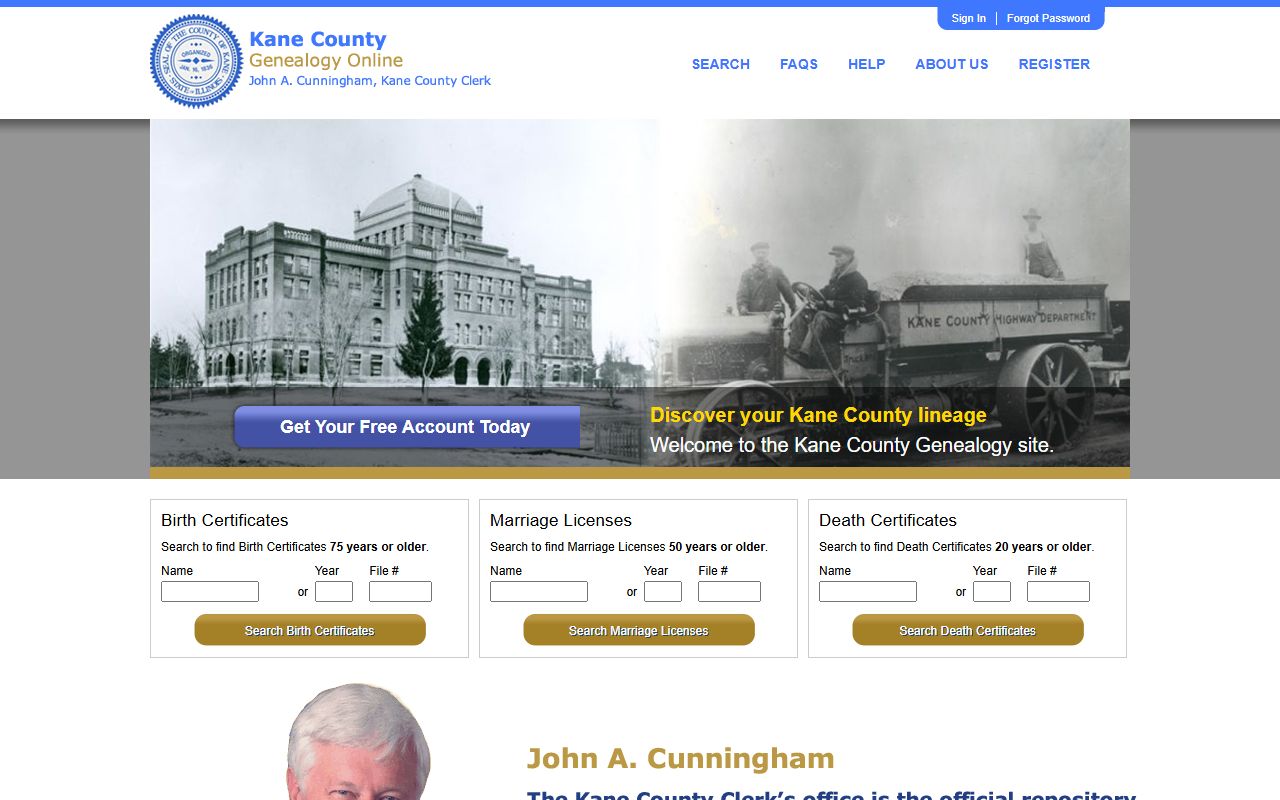
The genealogy index is a good first stop for a marriage from decades ago, but it is a finding aid; the certified document still comes from the County Clerk under its standard process.
Illinois Marriage Requirements
Illinois marriage rules come from the Illinois Marriage and Dissolution of Marriage Act, 750 ILCS 5. The same statute that allows a marriage also governs how a court can dissolve one. The Act covers eligibility, license issuance, who may officiate, and the recording of the signed license. The County Clerk applies these rules at the counter.
One common question has a simple answer. Illinois does not require a blood test to get married. That requirement was dropped years ago and does not apply in Kane County or anywhere in the state. Couples should still confirm age rules, prior-marriage documentation, and the license validity window on the current County Clerk page, because those details do carry real conditions.
Adoption can also touch family records, and Illinois handles it under the Adoption Act, 750 ILCS 50. Adoption files are confidential and are not part of a public marriage or divorce search.
Kane County Divorce Records (Circuit Clerk)
Divorce records are court records. A divorce, called a dissolution of marriage in Illinois, is a family case filed in the Circuit Court. The Kane County Circuit Clerk is the custodian of that case file, including the petition, motions, orders, and the final judgment. This is the office to call for a divorce decree, at 630-232-3413.
This is the part people get wrong. The County Clerk issues the marriage license, but the County Clerk does not hold the divorce file. Divorce decrees come from the Circuit Clerk. A request for a certified divorce judgment that goes to the wrong office gets bounced. Send divorce requests to the Circuit Clerk, and send marriage requests to the County Clerk.
A divorce file can hold a lot. It may include the dissolution petition, financial affidavits, a parenting plan, support orders, temporary orders, and the final decree. Much of it is public, but not all. Cases that involve minor children, financial accounts, or home addresses can carry restrictions, which the next sections cover. For broader case context, see Kane County court records.
Searching Kane County Divorce Dockets
Public divorce docket data is searched in the same Tyler Odyssey portal used for other Circuit Court cases. The Kane County court portal exposes a Smart Search box that accepts a party name or a case number. A divorce case usually carries a family or dissolution case type code. Restricted parties and confidential data may be filtered out before a result reaches the screen.
Have the basics ready before you search. A case number from a decree or court notice gives the cleanest single result. A spouse name still works, but common names produce long lists. The fields below show what the portal search accepts for a divorce lookup.
| Field Label | Type | Required | Options / Format Notes |
|---|---|---|---|
| Party name | Text | Optional | Search a spouse name; restricted parties may not show full detail. |
| Case number | Text | Optional | Best if known from the decree or a court notice. |
| Case type / category | Dropdown (if visible) | Optional | Family, dissolution, or domestic relations. |
| Filing date range | Date | Optional | Narrows older divorce filings to a chosen window. |
| Search | Button | n/a | Runs the query. |
The Odyssey portal is the same dashboard shown on the Kane County public case access page.
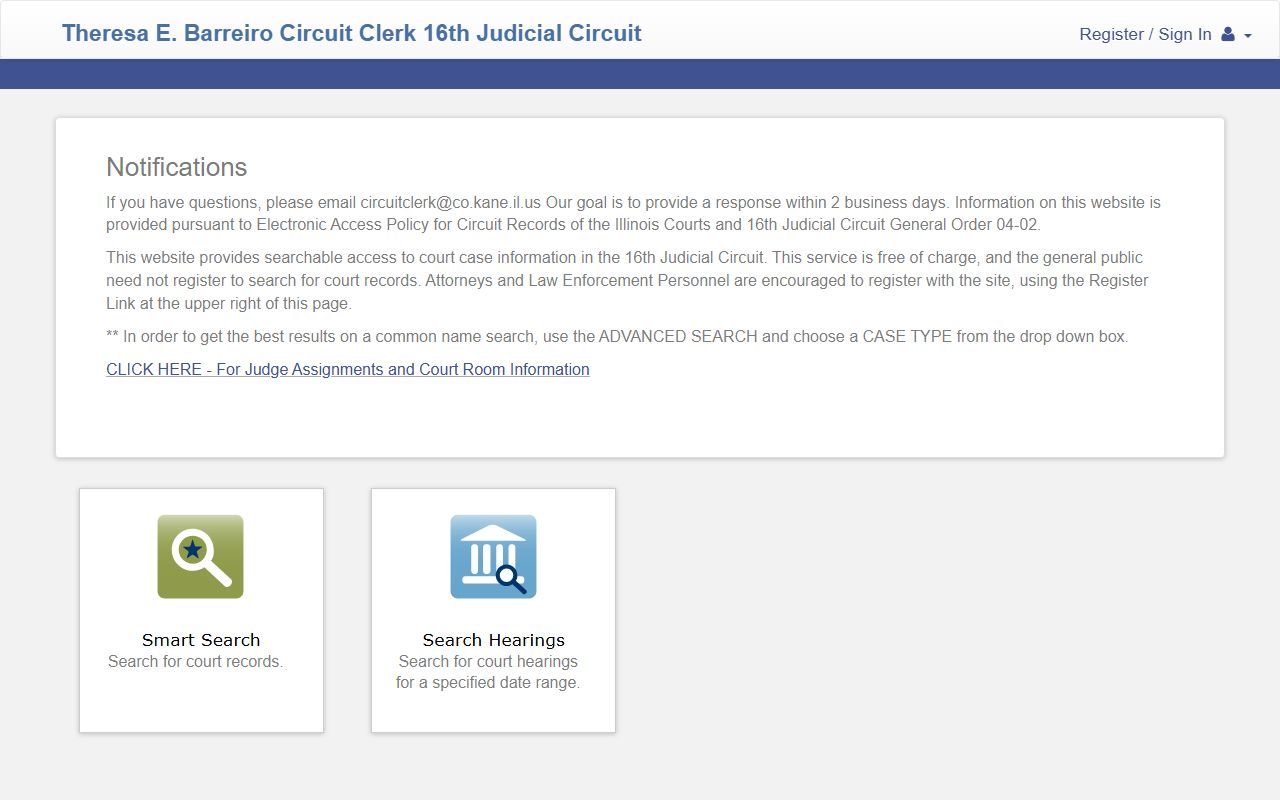
The portal returns docket entries and hearing dates for a public divorce case; a stamped certified decree still comes from the Circuit Clerk.
Filing for Divorce in Kane County
A Kane County divorce moves through a set sequence of steps. Illinois requires e-filing for most civil matters, including dissolution, through the statewide eFileIL system. Self-represented filers can use the same system, and a fee waiver is available for those who qualify. The Circuit Clerk links the electronic systems on its site.
- Confirm venue and residency so Kane County is the correct county to file in.
- Use Illinois court-approved dissolution forms or attorney-drafted pleadings.
- File the petition with the Kane County Circuit Clerk, generally through eFileIL unless exempt.
- Pay the filing fee, or request a fee waiver with an Application for Waiver of Court Fees if eligible.
- Serve the other spouse, unless filing jointly where the rules permit.
- Attend case-management, mediation, temporary-order, prove-up, or trial dates as the court orders.
- Obtain the final judgment for dissolution from the Circuit Clerk after the court enters it.
Court staff and the Circuit Clerk can hand out forms and explain procedure, but they cannot give legal advice. The dissolution process itself runs under 750 ILCS 5, which sets the rules for grounds, property, support, and parenting.
Confidential Family Information in Kane County Divorce Cases
Not every part of a divorce file is open. Illinois court rules redact sensitive data from public view. Social Security numbers, financial account numbers, and similar identifiers are filtered out. When a case involves minor children, the court can restrict child information, financial detail, and home addresses to protect the family.
The Circuit Clerk is the custodian of these files under the Clerks of Courts Act, 705 ILCS 105. That law makes the clerk responsible for case files, dockets, fees, and certified copies. The clerk applies the redaction and access rules set by statute and the courts, so some documents that exist in a file will not appear to an anonymous portal user.
A third party who needs sealed or restricted divorce material usually needs a court order or a statute that allows access. The motion should name the case, the document, and the legal basis for the request.
Marriage Records vs Divorce Records in Kane County
The fastest way to avoid a wasted trip is to match the record to the right office. Marriage records sit with the County Clerk. Divorce records sit with the Circuit Clerk. The table lays the split out side by side so a request goes to the correct counter the first time.
| Marriage Records (County Clerk) | Divorce Records (Circuit Clerk) | |
|---|---|---|
| Custodian | Kane County Clerk (John A. Cunningham) | Kane County Circuit Clerk |
| What they hold | Marriage license and recorded marriage certificate | Dissolution case file: petition, orders, and the final divorce decree |
| Where to search | County Clerk vital records and the genealogy index | The Odyssey court portal by party name or case number |
| Certified copy | Certified marriage certificate from the County Clerk | Certified divorce decree from the Circuit Clerk |
Note: A marriage license that ends in divorce still leaves two separate records in two offices, so a full history may need a request to both the County Clerk and the Circuit Clerk.
Fees and Self-Help Resources
Fees for these records are set by the office that holds them. The County Clerk sets marriage license and certified marriage copy fees. The Circuit Clerk sets divorce filing and certified decree fees. The amounts were not located in the official sources reviewed, so confirm the current fee on the right office page before you pay. Do not rely on a number from anywhere else.
| Item | Fee |
|---|---|
| Marriage license | Set by County Clerk; confirm current fee on the marriage license page. |
| Certified marriage certificate | Set by County Clerk; confirm current fee on the vital records page. |
| Genealogy copy / index search | Index is free to search; copies set by County Clerk, confirm current fee. |
| Divorce filing | Set by Circuit Clerk; confirm current fee, fee waiver available if eligible. |
| Certified divorce decree | Set by Circuit Clerk; confirm current fee before mailing payment. |
People who file without a lawyer have free help. Illinois Legal Aid Online publishes plain-language guides and court-approved forms for divorce, parenting, support, and fee waivers. It is the statewide self-help resource that Illinois courts commonly point to. Start there for forms and instructions, then file with the Circuit Clerk.
For related Kane County records, see the Kane County Clerk for marriage and vital records, the Circuit Clerk for divorce case files, Kane County probate records for estates and guardianships, and Kane County public records for the broader FOIA process. The Kane County records FAQ answers common questions about which office holds what.