
How to Look Up Kane County Jail Population Data
Kane County does not publish a single, branded jail population dashboard. The closest live source is the Sheriff's public detainee tool at applications.kanecountyil.gov/DETAINEESEARCH/. That tool exposes three list views that, taken together, give a working snapshot of who is in custody right now and who has come in or gone out over the last three days. The In Custody view returns the names held at that moment. The 72-hour Received view returns recent bookings. The 72-hour Released view returns recent releases. The numbers shift on every refresh.
For yearly or multi-year figures, the source is the Kane County Sheriff's annual report and any budget or board documents tied to the Public Safety Building. The 2021 annual report describes a jail capacity of 640 detainees inside the Public Safety Building on Illinois Route 38. The report file lives on the Sheriff's site. National and state context comes from the Bureau of Justice Statistics at bjs.ojp.gov and from the Vera Institute Incarceration Trends tool at incarcerationtrends.vera.org. Those two outside sources are useful for framing, not for live county counts.
Reading the data takes care. The detainee tool is a snapshot, not an average. The Sheriff's annual report is a yearly summary, not a daily figure. BJS and Vera publish state and national rates, not Kane County point-in-time counts. Mixing the three sources in one breath is a common mistake. Each one has a different unit of time, a different scope, and a different update cadence. A reader who wants a clean answer should pick the source that matches the question first.
The Sheriff's patrol and public safety page lays out the county footprint that the jail serves. The page at kanesheriff.com/pages/patrol-public-safety-division.aspx describes 522 square miles of county area, thirty municipalities, and a 2010 Census reference population of 515,269. Those figures matter when comparing Kane County jail counts to peer counties of different sizes.
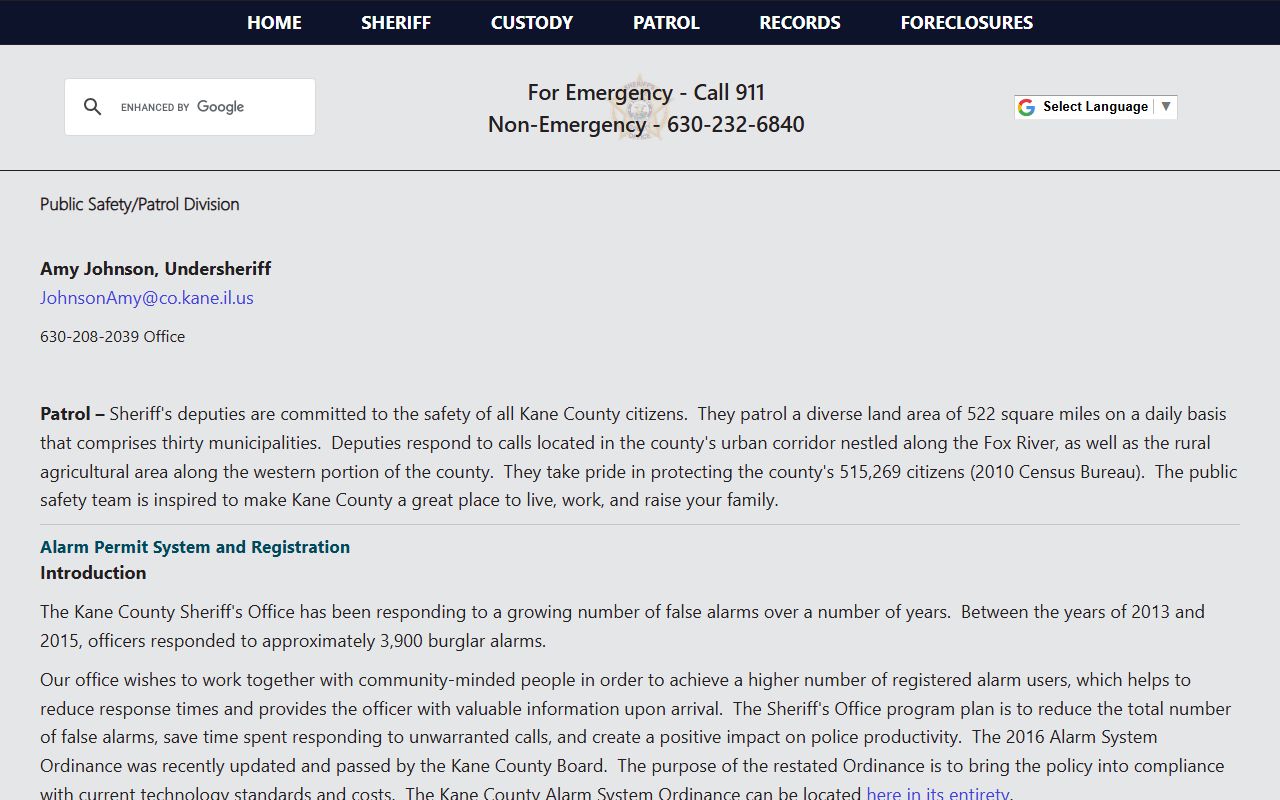
The Sheriff page is the cleanest single source for the county-level scope that frames any jail population count.
Kane County Jail Capacity
Kane County runs a single adult jail. The building is officially the Kane County Adult Justice Center, also called the Kane County Jail, sitting inside the larger Public Safety Building at 37W755 Illinois Route 38 in St. Charles. The published capacity comes from Sheriff's annual report language and lists 640 detainees. That figure is rated capacity, not a live count. Live counts move with bookings, releases, transfers, and holds.
| Facility | Address | Capacity | Phone |
|---|---|---|---|
| Kane County Adult Justice Center (Kane County Jail) | 37W755 Illinois Route 38, St. Charles, IL 60175 | 640 detainees | Sheriff non-emergency 630-232-6840; jail 630-232-6677; intake/release 630-208-2083 |
The Adult Justice Center is the only jail in Kane County. There is no second county facility, no work release annex, and no separate municipal jail run by the county. Local police departments in Aurora, Elgin, Geneva, Batavia, and the other municipalities use short-term holding cells, but most detainees move to the Adult Justice Center within hours. Federal holds, IDOC transfers, and other-county holds can keep a detainee booked here past the point a local bond would otherwise release them.
Capacity is not the same as a target population. Jails run below rated capacity for safety, classification, and medical reasons. A 640-bed rating does not mean the Sheriff aims for 640 detainees on any given day. Capacity is the legal and operational ceiling.
Average Daily Population in Kane County
Average daily population, often shortened to ADP, is the standard yearly measure for a jail. ADP averages the head count taken at the same time each day across a defined period, usually a calendar year or fiscal year. Counties that publish ADP usually print it in a sheriff annual report, a county budget book, or a public safety committee packet.
Kane County has not published a public five-year ADP dashboard in the official sources reviewed for the Adult Justice Center. The detainee search shows live counts, not averages. The Sheriff's site focuses on services, bonds, mail, visits, and FAQ rather than population dashboards. Readers who need an exact Kane County ADP figure should request the most recent Sheriff's annual report directly, or file a public records request under the Illinois Freedom of Information Act at 5 ILCS 140, which lets a member of the public ask any public body for non-exempt records.
One workable proxy is to compare the In Custody list size at the detainee tool across several visits, then average the figures. The result is informal and should not be cited as official. It works as a rough sense of scale.
Demographic Breakdown of the Kane County Jail
Jails that publish demographic data usually report gender, race or ethnicity, age bands, and sometimes residence within or outside the county. Those breakdowns matter because they show whether a jail population mirrors the wider community or skews along any axis. Booking systems in Illinois capture each of those fields at intake, so the underlying data exists even when a public report does not.
The Kane County Sheriff has not posted a public demographic breakdown of the Adult Justice Center population in the official materials reviewed. The detainee search exposes each detainee's name, booking number, charges, and bail picture on the individual profile, but it does not roll up a gender or race summary on the public site. A reader who needs that breakdown can ask the Sheriff's Office under FOIA or request the latest annual report.
For framing, Kane County's overall 2010 reference population was 515,269 across 522 square miles and thirty municipalities. Aurora is the largest population center, then Elgin, with smaller hubs in Geneva, Batavia, St. Charles, and the Tri-City corridor along the Fox River. Any demographic comparison of the jail to the county should start from that wider footprint.
Pretrial vs Sentenced Population in Kane County
Jail populations split into two main groups. The first group is pretrial detainees: people booked, charged, and waiting for trial or a plea. The second group is sentenced detainees: people serving a short jail sentence after a guilty plea or verdict. Long state prison sentences do not stay in a county jail; those move to the Illinois Department of Corrections.
The split matters. Pretrial detainees have not been convicted. Sentenced detainees have. The same building holds both groups, but the legal status is very different, and so are the constitutional protections. A pretrial count climbing while a sentenced count stays flat usually points to bond practice or case backlog, not to a rise in convictions.
| Population Type | What It Means |
|---|---|
| Pretrial | Charged but not yet convicted. Held because of bond conditions, no bond, or a detention order. |
| Sentenced | Convicted and serving a jail sentence. In Illinois, sentences served in a county jail are usually under one year. |
| Holds and detainers | Held for another agency, such as IDOC, ICE, or another county. Local bond may not release the detainee. |
Kane County has not published a public pretrial-versus-sentenced split for the Adult Justice Center in the sources reviewed. The Sheriff FAQ confirms that IDOC, ICE, and other-county holds can prevent release after a local bond is posted, which means the holds row above is a real share of the in-custody count, not a footnote.
Misdemeanor vs Felony Population in Kane County
Charge level is another way to slice a jail population. Misdemeanor detainees face shorter possible sentences and usually have lower bond amounts. Felony detainees face longer possible sentences and higher bond. A small share of the felony count will move on to IDOC after sentencing; the misdemeanor count generally stays inside the county system.
Charge level is set by the charging document. A Kane County criminal case caption shows CF for a felony, CM for a misdemeanor, DT for DUI, TR for traffic, and MT for misdemeanor traffic. Booking screens record the most serious charge at intake, though that charge can be reduced, dismissed, or replaced as the case moves. A jail population snapshot pulled on any single day mixes detainees at every stage of that process.
Kane County's public detainee tool shows the charge on the individual profile, but it does not group the in-custody list by charge level. A reader who needs a felony-versus-misdemeanor share for a specific date should ask the Sheriff's Office for that day's classification report.
Mental Health and Medical Population in Kane County
Some share of any jail population needs mental health care, medical care, or both. National research has found that jails carry a higher mental health and substance use burden than the general public, which is one reason BJS publishes a periodic special report on the topic. Counties handle that need through medical staff, contracted providers, and connections to outside hospitals when a detainee needs more care than the jail can give.
Kane County does not publish a public count of detainees receiving mental health or medical services. That data is protected for individual privacy reasons under federal and state law, and a count by itself would not be useful without context. The volunteer services page at the Adult Justice Center describes programs that touch this group, including substance abuse and behavior awareness work, but those are program lists rather than population numbers.
A reader who needs care information about a specific detainee should contact the jail at 630-232-6677. The general detainee services page at kanesheriff.com/Pages/Adult-JC-Corrections-Detainee-Services.aspx lays out the framework for medical, mental health, and other services inside the building.
National and State Context for Jail Population
National and state context helps frame any county jail figure, even when local numbers are thin. The Bureau of Justice Statistics is the main federal source. BJS publishes the Jail Inmates series, the Census of Jails, and special reports on pretrial, mental health, and medical conditions. Vera Institute's Incarceration Trends tool pulls county-level data from BJS and other sources and lets a reader look up a specific county, including Kane, for context. Neither source produces a live Kane County count. Both are best used for state-level and national-level comparison.
| Source | What It Covers | URL |
|---|---|---|
| Bureau of Justice Statistics | National and state jail population reports, pretrial reports, mental health reports. Not Kane-specific live data. | bjs.ojp.gov |
| Vera Institute Incarceration Trends | County-level historical incarceration context built on federal data. Useful for comparing peer counties. | incarcerationtrends.vera.org |
| Illinois Department of Corrections | State prison custody, not county jail. Use to track a former Kane County detainee after sentencing to state time. | idoc.illinois.gov |
BJS and Vera figures should never be cited as Kane County current counts. They are framing, not a feed. A national jail rate per 100,000 residents is a useful yardstick, but it should be presented as such, not as a Kane-specific number.
The BJS landing page is the entry point for jail and prison statistical reports that can frame any Kane County jail population question.
County Jail Population vs State Prison Population
A common confusion runs through jail population questions: the Kane County jail and the Illinois state prison system hold different people for different reasons. A jail data page that mixes them up will frustrate readers who came in with one question or the other. The clean rule is short. Jails hold pretrial detainees and short sentences. Prisons hold longer sentences.
| Kane County Jail | Illinois Department of Corrections |
|---|---|
| Adult Justice Center on Route 38, St. Charles. | State-run prisons across Illinois. |
| Holds pretrial detainees and people serving short jail sentences (usually under one year). | Holds people serving longer sentences after a state-court conviction. |
| Run by the Kane County Sheriff. | Run by the Illinois Department of Corrections. |
| Public detainee tool at applications.kanecountyil.gov/DETAINEESEARCH/. | State inmate search at idoc.illinois.gov/offender/inmatesearch.html. |
| Capacity 640 detainees. | Statewide capacity across many facilities; published in state corrections reports. |
A reader who needs IDOC numbers will not find them on the Kane County Sheriff site. A reader who needs Kane County detainee counts will not find them on the IDOC site. The detainee tool and the IDOC search are separate systems with separate update rules and separate scopes.
Population Trends and the 2025 Pretrial Context
Illinois moved to a cashless pretrial system after the SAFE-T Act and the related Pretrial Fairness Act took full effect. Cash bond is no longer the standard tool for pretrial release. Judges decide detention based on charge and risk factors rather than the ability to post cash. That change affects jail population in two ways. Some detainees who would have stayed in custody because they could not pay are now released pretrial. Some detainees who would have bonded out under the old system are now held under a detention order.
Kane County State's Attorney Jamie Mosser was elected president of the Illinois State's Attorneys Association in December 2025. The release announcing the election quotes Mosser discussing SAFE-T Act implementation, cashless bail, technology in crime prevention, diversion, rehabilitation, and prosecution of dangerous offenders. The release is available at the State's Attorney's news page on the county site. Readers comparing recent Kane County pretrial numbers to figures from before the SAFE-T Act should expect the makeup of the pretrial group to look different, even if the headline jail count moves only a little.
Daily counts also move for reasons that have nothing to do with policy. Court orders, bond posts, IDOC transfers, hospital and medical movement, warrant arrests, and other-agency holds all push the in-custody count up or down. Reading any single day's number as a trend is a mistake.
Kane County Jail Population Terms
The same six or seven words show up in almost every jail population report. They sound similar and they overlap. The Sheriff's site does not run a glossary, so a quick definition list is worth having before reading a report or a release.
- Average Daily Population (ADP)
- Average head count taken at the same time each day across a year or other period.
- Capacity
- Rated or operational beds for a jail. Kane County's Adult Justice Center is rated at 640 detainees.
- Pretrial Detention
- Holding a person who has been charged but not yet convicted, usually because of bond or a detention order.
- Sentenced Population
- Detainees serving a jail sentence after a guilty plea or verdict. State prison sentences go to IDOC instead.
- Holds and Detainers
- A request from another agency, such as IDOC, ICE, or another county, to keep a detainee booked.
- Admissions
- People received into custody during a defined period, also called bookings.
- Releases
- People released from custody during a defined period through bond, sentence completion, dismissal, or transfer.
The flow of a single day connects every term: Current Custody › Admissions during the day › Releases during the day › Transfers to IDOC or another jurisdiction › New Current Custody at the end of the day.
Searching for Kane County Inmate Records by Name
This is a population data page, not a roster. Individual name lookups, booking numbers, mugshots, charges, and bail figures live with the live jail roster. Use the Kane County inmate records page for a name search of the Adult Justice Center detainee list. For people who recently left local custody, use the Kane County released inmates page.
Where the Kane County Jail Data Comes From
Kane County jail data has four main sources. The first is the live detainee search at applications.kanecountyil.gov/DETAINEESEARCH/. That source updates around the clock and gives the cleanest in-custody count the public can pull. The second is the Sheriff's annual report, which includes population and capacity language. The Sheriff's 2021 annual report PDF is hosted on the Sheriff's site under the Documents folder.
The third source is a public records request to the Sheriff's Office under the Illinois Freedom of Information Act, 5 ILCS 140. A FOIA request is the right tool for any specific figure, including a clean ADP, a demographic breakdown, or a pretrial-versus-sentenced split. The Sheriff's Office can respond with the most recent classification report, jail roster summary, or annual figures. The fourth source is outside research bodies. BJS at bjs.ojp.gov publishes national and state jail data. Vera at incarcerationtrends.vera.org publishes county-level historical context built on federal data. Neither outside source replaces a local FOIA when a researcher needs a real Kane County number.
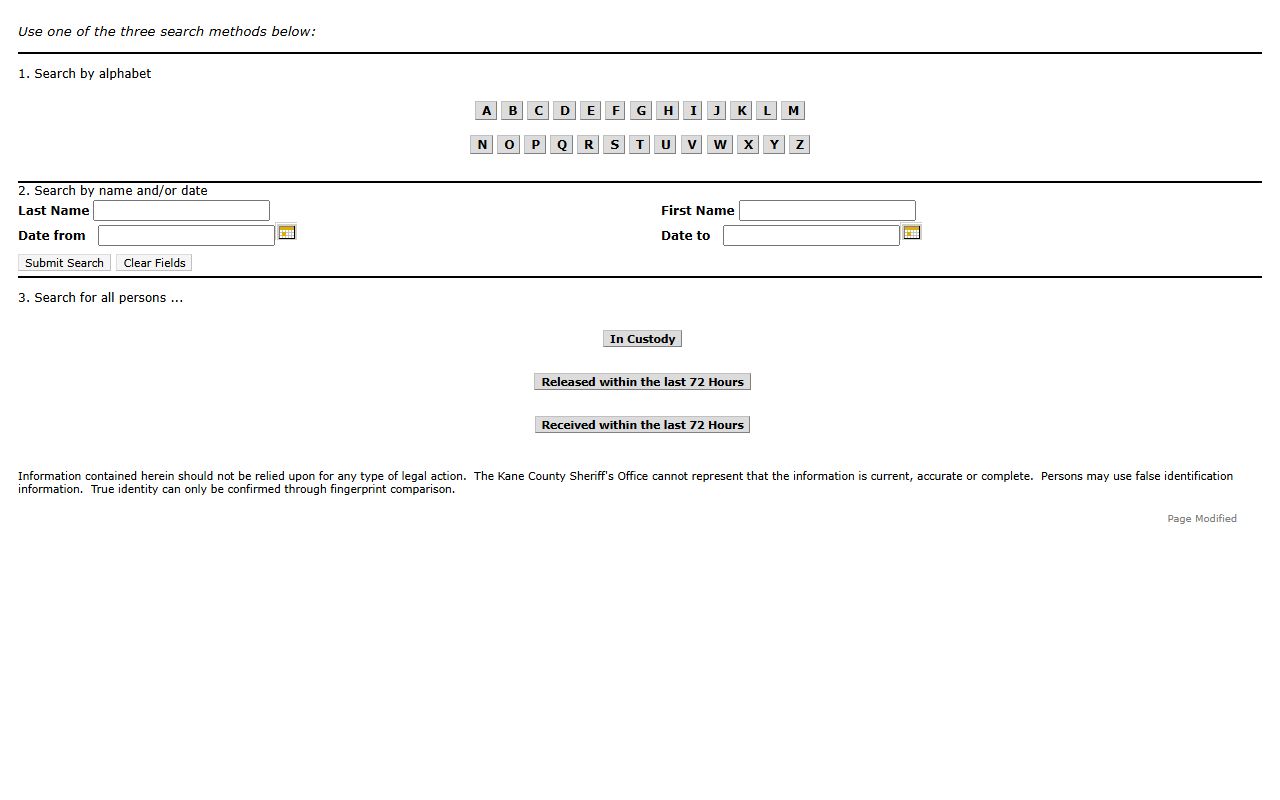
The detainee search is the live source behind almost any current Kane County jail population question.
Note: BJS and Vera publish state and national figures and historical context, not live Kane County counts.