
Kane County Public Records
Illinois does not run public access through a single door. The state splits it into lanes based on who holds the record and what kind of record it is. That is the first thing to grasp about Kane County public records. A court case file is not handled the same way as a county purchasing contract. A marriage license is not handled the same way as a sheriff incident log. Each lane has its own office, its own rules, and its own fees.
There are four main lanes. Court case files go to the Kane County Circuit Clerk under court rules. County administrative records, such as department budgets and contracts, go through Illinois FOIA at Kane County government. Marriage, vital, and election records go to the Kane County Clerk, John A. Cunningham. Federal records connected to a Kane County person or business sit in a separate federal system entirely.
Why does the split matter so much? Because asking the wrong office gets a denial, not the record. A FOIA request sent to the Circuit Clerk for a court file will not produce that file the way an in-portal search would. A motion sent to a county FOIA officer for a sealed court record will not unseal anything. Match the record to the lane first.
Kane County government publishes an ADA accessibility statement for users who need records in an accessible format. The county homepage is the front door for most administrative and FOIA matters.
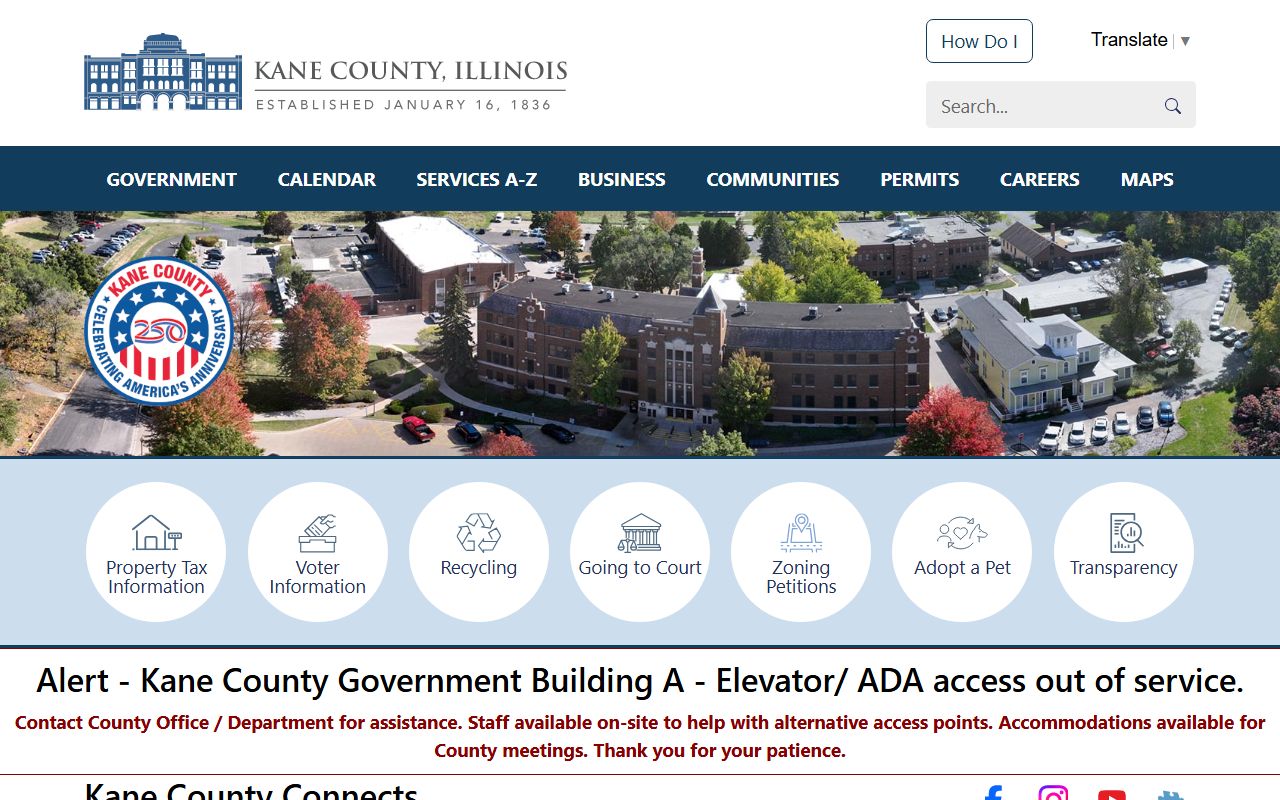
The county homepage links departments, the FOIA process, county maps, and public services, so it is the right starting point for any administrative record that is not a court case file.
Illinois FOIA and Kane County Records
The Illinois Freedom of Information Act is the open-records law for public bodies. It sets the public policy that records of public bodies should be open unless a specific exemption applies. The law gives request procedures, response deadlines, exemptions, and a review path through the Attorney General's Public Access Counselor. It is found at 5 ILCS 140.
FOIA applies to Kane County administrative records. Think department budgets, board minutes, contracts, vendor payments, policy manuals, and sheriff records that are not court case files. A Kane County resident, a business, a reporter, or anyone else can file a FOIA request with the county. The requester does not have to say why the record is wanted, except where the request is for a commercial purpose, which the law treats differently.
FOIA has limits. It does not automatically override a court sealing order or a confidentiality statute. A record that is sealed by a judge stays sealed even if someone files a FOIA request for it. Juvenile, adoption, mental health, and certain investigative records carry their own protections that FOIA respects rather than breaks. The law is a strong tool, but it is not a master key.
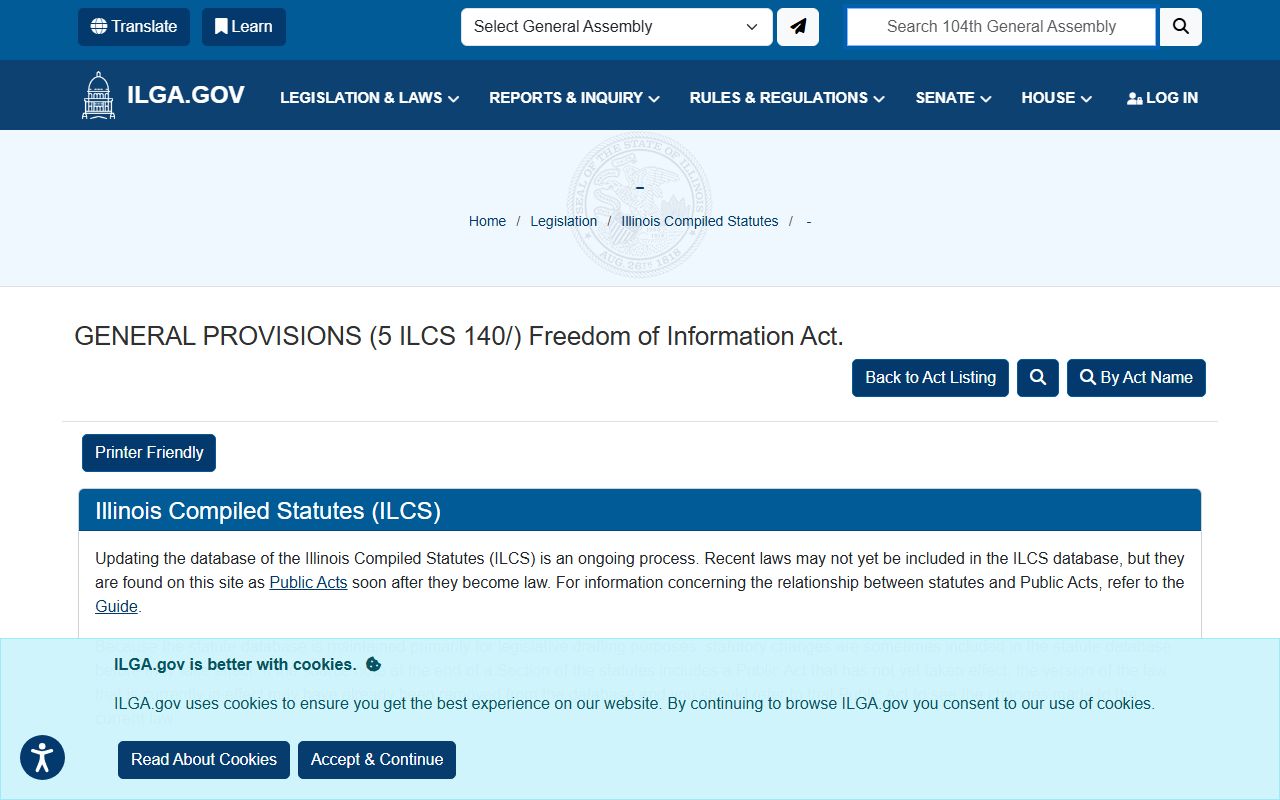
The Illinois statute page lays out the full text of the Freedom of Information Act, including the exemptions a public body may cite when it withholds part of a record.
Court Records vs FOIA Records in Kane County
The most common mistake is treating a court file like a FOIA record. They run on different rules. A court case file is held by the Circuit Clerk under the Clerks of Courts Act, not under FOIA. The clerk is the statutory custodian of case files, dockets, fees, and copies. Court records are searched through the Odyssey portal, and certified copies come from the clerk, not from a county FOIA officer.
A county administrative record runs the other way. It is held by a public body and reached through a FOIA request. The fee rules, the appeal route, and the request method all differ from the court side. The table below sets the two lanes side by side so the difference is plain before a request goes out.
| Point | Court Case Files | FOIA Records |
|---|---|---|
| Custodian | Kane County Circuit Clerk | Kane County public body or department |
| Governing Rules | Clerks of Courts Act and court rules (705 ILCS 105) | Illinois Freedom of Information Act (5 ILCS 140) |
| Where to Request | Odyssey portal or the Circuit Clerk office | County FOIA officer or department FOIA contact |
| Fee Authority | Set by Circuit Clerk fee authority | Limited by Illinois FOIA fee rules |
| Appeal Route | Court motion or statutory access petition | Attorney General Public Access Counselor or court |
For the court side in depth, see the Kane County court records page and the Kane County Circuit Clerk page. Court case files for civil, criminal, traffic, family, and probate matters all live with the clerk and run through the portal at kanecoportal.co.kane.il.us/portal.
Which Office Holds Which Kane County Records
Most failed requests come from sending the right question to the wrong office. The fix is a quick map. Kane County splits records across the Circuit Clerk, the County Clerk, county departments, the Sheriff, and the federal courts. Each office owns its own slice. The table below maps the common record types to the office that holds them and the way to ask.
| Record Type | Office | How to Request |
|---|---|---|
| Court case files (civil, criminal, traffic, family, probate) | Kane County Circuit Clerk | Odyssey portal search; certified copies from the clerk |
| Marriage, birth, death, election records | Kane County Clerk | County Clerk request process and vital-record rules |
| County budgets, contracts, board minutes, department records | Kane County FOIA officer | Written FOIA request under 5 ILCS 140 |
| Sheriff non-court records (incident logs, policies, reports) | Kane County Sheriff | FOIA request to the Sheriff as a public body |
| Federal civil, criminal, bankruptcy filings | U.S. District Court, Northern District of Illinois | PACER electronic record search |
Sheriff custody data is its own thing again. Current jail bookings and recent releases are searched through the public detainee tool, not through a FOIA request. For that, see the Kane County inmate records page. A FOIA request to the Kane County Sheriff is the right path for non-court records like policies, statistics, and incident reports that the office keeps as a public body.
How to File a Kane County FOIA Request
A FOIA request to Kane County government is not complicated, but a clear request gets a faster answer. The goal is to describe the record well enough that staff can find it without guessing. Vague requests draw clarification letters and delay. A tight request that names the department, the date range, and the document type tends to move fast.
The steps below outline a typical Kane County FOIA request for an administrative record. Court case files do not follow this path; those go through the Circuit Clerk and the Odyssey portal instead.
- Confirm the record is a FOIA record, not a court file. Court case files go to the Circuit Clerk, not the FOIA officer.
- Identify the right public body. A county department, the Sheriff, or another Kane County public body each takes its own request.
- Write the request. Name the records clearly, give a date range, and state the format you want.
- State if the request is for a commercial purpose, since the law treats commercial requests differently.
- Submit it to the body's FOIA officer in writing, then keep a dated copy for your records.
- Wait for the statutory response window. If the body denies the request, ask the Attorney General Public Access Counselor or the court to review.
Keep the request narrow at first. A broad request that sweeps in thousands of pages can trigger an extension, a fee estimate, or a partial denial. If the first answer is too thin, a follow-up request can widen the scope. Note: A FOIA request cannot pry open a sealed court record, so a sealed-file question belongs in a court motion, not a FOIA letter.
The Kane County FOIA Request Form
A FOIA request does not need a fancy form, but it does need certain pieces of information. A public body can act faster when the request supplies all of them at once. The field set below covers what a typical Kane County FOIA request should include. Some fields are required, and some only matter in certain cases, such as a commercial request or a fee waiver.
| Field | Required | Notes |
|---|---|---|
| Requester name | Yes | The person or business asking for the record |
| Contact information | Yes | Mailing address, email, or phone for the response |
| Records described | Yes | Name the documents, the department, and a date range |
| Format requested | No | Paper copies, electronic files, or inspection in person |
| Commercial-purpose statement | Conditional | Required if the records are sought for a commercial purpose |
| Fee waiver request | No | Ask for a waiver or reduction if the request serves the public interest |
The records-described field does the heavy lifting. A request for "all emails" is too broad and may be denied or estimated at a high fee. A request for purchasing contracts signed by one named department between two named dates is something staff can pull. Specificity is the difference between a quick yes and a long back-and-forth.
Kane County Clerk Records
The Kane County Clerk is an elected office, separate from both the Circuit Clerk and the county FOIA officer. The clerk handles marriage licenses, birth and death records, elections, tax extension functions, and county board records where assigned. John A. Cunningham serves as County Clerk, with Celeste Weilandt as Chief Deputy. People often confuse this office with the court clerk and send the wrong request.
Here is the key split. A marriage license comes from the County Clerk. A divorce decree comes from the Circuit Clerk, because divorce is a court case. So a couple gets their license from one office and, years later, would pull a dissolution file from a different office. For marriage and divorce details, see the Kane County divorce records page; for the clerk office in full, see the Kane County Clerk page.
Vital records carry eligibility and identification rules under Illinois law. Not every birth or death certificate is open to any requester. The County Clerk also runs a genealogy index for historical birth, marriage, and death searches. That index is public-facing, but a certified copy still goes through the clerk's official request process.
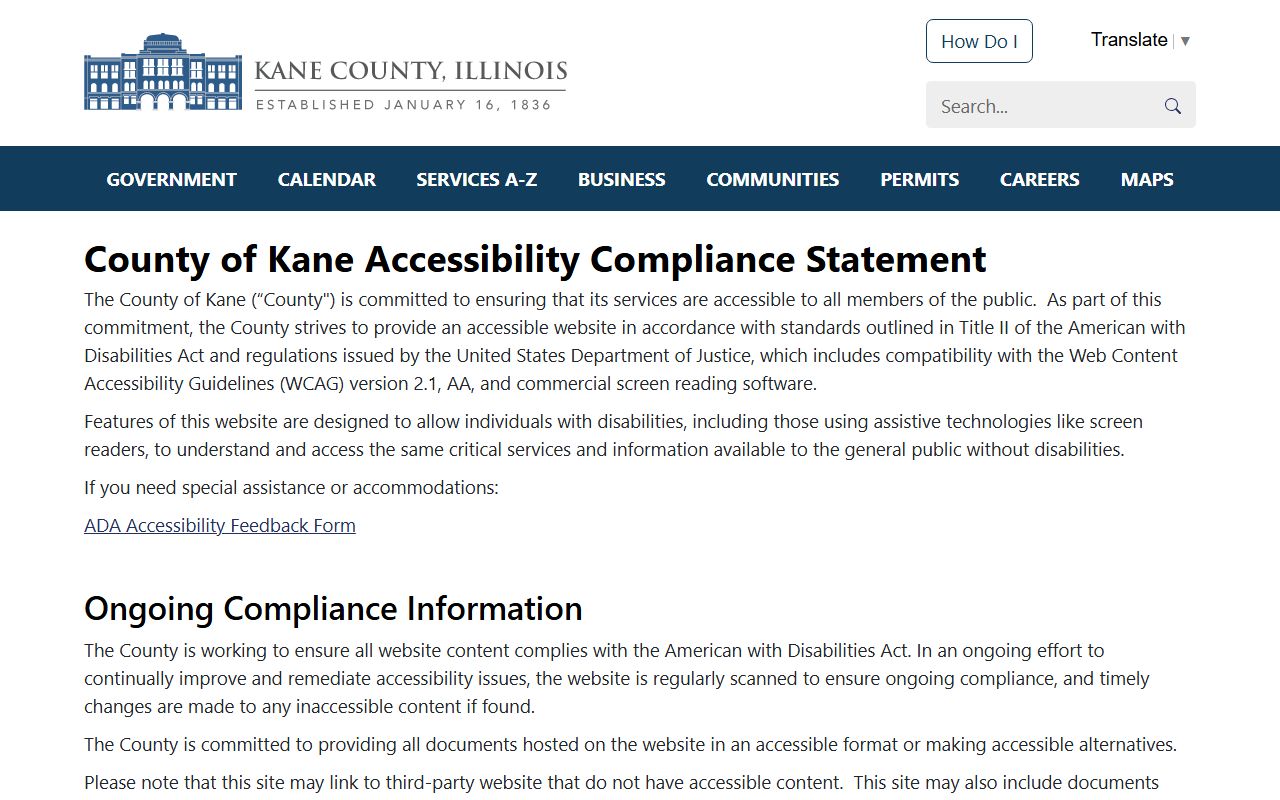
The county web accessibility page explains how to request records in an accessible format, which matters for anyone who needs a public record in an alternate form.
Kane County Sheriff and Custody Records
Sheriff records split into two kinds, and the split trips people up. Current custody data, recent bookings, and recent releases are searched through the public detainee tool. That is not a FOIA matter. It is a live lookup that the Sheriff runs for the public, and it returns custody status within the jail.
The other kind is the administrative record. Policies, statistics, incident reports, and similar documents that the Kane County Sheriff keeps as a public body fall under FOIA. A request for those goes to the Sheriff as a public body under 5 ILCS 140, the same way a request to a county department would. Sheriff Ron Hain leads the office, which runs the Adult Justice Center in St. Charles.
One caution applies to both kinds. Active investigative files, confidential sources, and security-sensitive material can be exempt from FOIA while an investigation is open. The law lets a public body withhold those parts. For booking, charge, and bond detail on a person in custody, the inmate page is the better route than a FOIA letter.
Restricted and Confidential Kane County Records
Not every Kane County record is open, and FOIA does not change that. Several categories are closed by statute no matter who asks or which office holds them. A request for one of these records draws a denial, and the denial is usually correct under the law. Knowing the closed categories saves a wasted request.
Juvenile delinquency and abuse or neglect records are restricted under the Juvenile Court Act of 1987, 705 ILCS 405. Access is limited to parties, attorneys, agencies, and persons a court authorizes. Adoption files are confidential under the Adoption Act, 750 ILCS 50. Mental health proceedings carry medical and psychiatric protections. Grand jury materials are not public unless later ordered disclosed.
Sealed and expunged adult criminal records are removed from public view under 20 ILCS 2630/5.2, the sealing and expungement section of the Criminal Identification Act. A FOIA request cannot reach a sealed file. The path to a sealed record is a court motion or a statutory access petition, filed in the circuit court, naming the case and the legal basis for access. The Kane County criminal records page covers sealing and expungement in more detail.
Fees for Kane County Public Records
Fees follow the lane, not a single county-wide rate. A FOIA copy fee follows the limits set in the Illinois Freedom of Information Act. A court copy fee follows the Circuit Clerk's own fee authority, which is a different rule entirely. A marriage or vital record fee follows the County Clerk's schedule. Mixing these up leads to surprise charges, so confirm the amount with the holding office before paying.
The table below marks which authority controls each fee. No dollar amounts are listed here on purpose, because each office publishes and updates its own current schedule. Always verify the current figure with the office that holds the record.
| Item | Notes |
|---|---|
| FOIA copy fee | Follows Illinois FOIA statutory limits; verify the current rate with the county FOIA officer |
| FOIA electronic record fee | Limited by FOIA rules; many electronic records carry low or no copy cost |
| Court record copy fee | Set by the Circuit Clerk fee authority, not by FOIA; verify before payment |
| Certified court copy | Set by the Circuit Clerk; required for many legal uses |
| Marriage license and vital records | Set by the Kane County Clerk; check the clerk schedule for the current amount |
| Fee waiver or reduction | FOIA allows a waiver where disclosure serves the public interest |
A fee waiver is worth asking for when the request serves the public interest rather than a private or commercial one. The public body decides the waiver, and a denial of a waiver can be raised with the Public Access Counselor. Note: A fee waiver for a court filing does not waive copy costs, so the two waivers are not the same thing.
Federal Records Connected to Kane County
Some records tied to a Kane County person, business, or address are not county records at all. They are federal. Federal civil, criminal, bankruptcy, and appellate filings do not appear in any Kane County system, and a county FOIA request will not reach them. These run through a separate federal track with its own portal and its own fees.
The federal trial court for the area is the U.S. District Court for the Northern District of Illinois, which covers Kane County. Federal case access runs through PACER, the national electronic record system. PACER requires a free account, and per-page fees apply for document access above a small threshold. PACER is not a FOIA system; it is the official federal docket service.
Bankruptcy filings sit in the U.S. Bankruptcy Court for the Northern District of Illinois, and federal appeals reach the Seventh Circuit Court of Appeals. None of those records pass through the Kane County Circuit Clerk or the county FOIA officer. For a quick recap of these access lanes and common questions, see the Kane County court records FAQ.